

20 Alternative Search Engines You Can Use Instead of Google (2026 Guide)
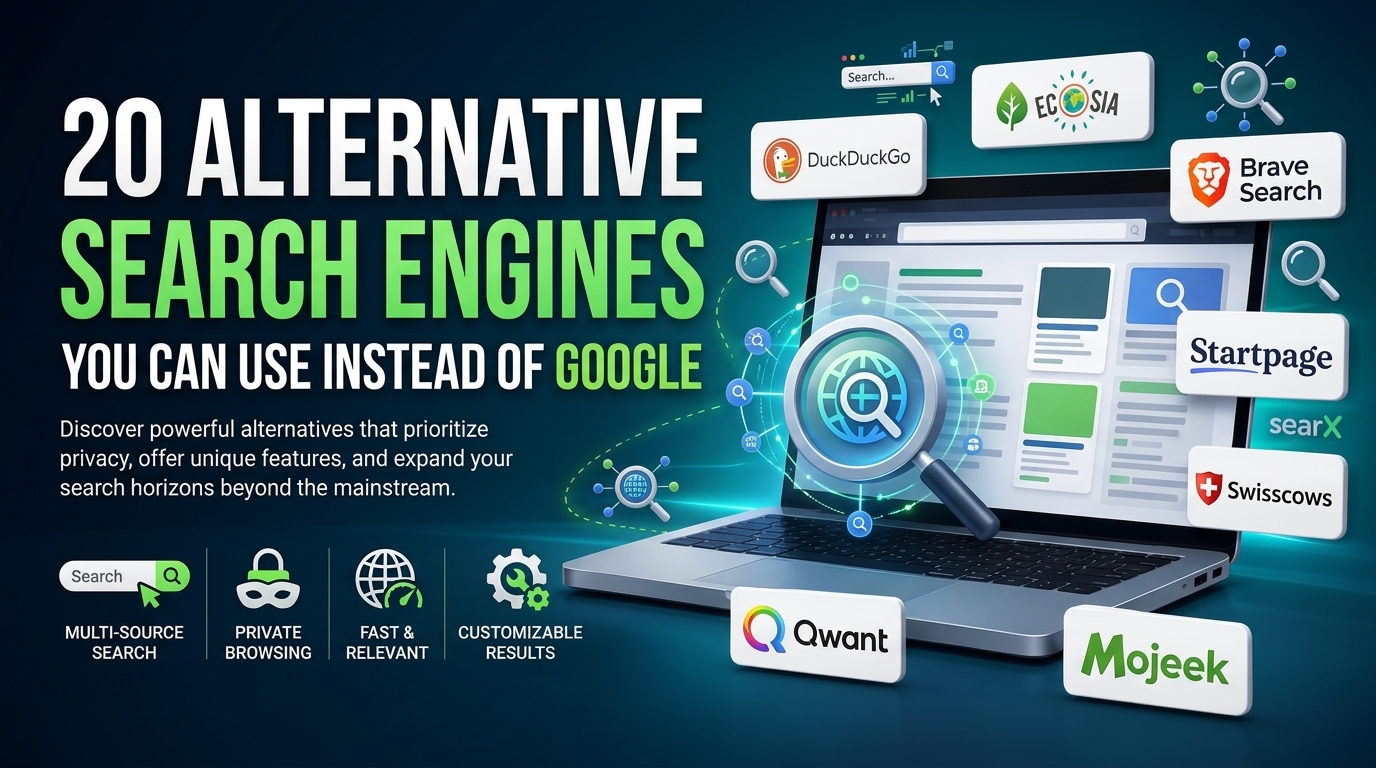
Google still handles the overwhelming majority of the world's searches, with its global share commonly cited above 85–90%. But dominant doesn't mean irreplaceable. Over the past few years, a growing ecosystem of alternative search tools has emerged around three big user demands: privacy, independence from Big Tech ad-tracking, and AI-powered answers in place of plain link lists.
Whether you're after a search engine that refuses to track you, one that funds tree planting with its profits, or one that hands you a direct, cited AI answer instead of ten blue links, there's now a genuine alternative for almost every use case. Here are 20 of the best Google alternatives worth trying in 2026, organized by what each one is actually good for.
Privacy-First Search Engines
These engines are built around a single core promise: they don't track, store, or sell your search history.
 DuckDuckGo
The most recognizable name in privacy search. DuckDuckGo shows every user the same results for the same query — no personalization, no tracking-based filter bubble. It leans on Bing and other partners for its underlying index rather than crawling the web itself, but for everyday private browsing it's still one of the most practical Google alternatives around.
Best For: Everyday searching without being tracked.
 Startpage
Startpage delivers Google-quality results without the Google-style data collection. It works as a privacy proxy: your query goes to Google anonymously, and the results come back to you without Google ever learning who searched. If you like Google's result quality but not its data practices, Startpage is the closest middle ground you'll find.
Best For: Google-style results without the tracking.
 Mojeek
One of the few truly independent search engines left standing. Mojeek runs its own crawler (MojeekBot) and its own index and ranking system rather than reselling Bing or Google results. It skips AI-compressed answers in favor of result diversity and exploration, and its newer "Focus" feature lets you build custom search spaces by including or excluding specific sites.
Best For: People who want a fully independent, non-Big-Tech index.
 Swisscows
A Switzerland-based, family-friendly engine that filters explicit content by default and doesn't log IP addresses or use tracking cookies. It draws on Bing's index for its web results.
Best For: Privacy-conscious users who also want built-in content filtering.
 Qwant
Qwant
A French search engine built to strict EU privacy standards. Qwant skips tracking and personalization entirely, and it's been collaborating with Ecosia on a jointly built European search index (EUSP) aimed at reducing Europe's reliance on U.S. search infrastructure.
Best For: Europe-based users who want a regionally independent, privacy-first engine.
Independent-Index & Mission-Driven Engines
 Brave Search
Brave Search isn't just a privacy wrapper — it runs its own independent index, reportedly covering around 40 billion web pages. It layers in AI-powered summarized answers alongside standard links and offers a paid, ad-free tier. Because it owns its infrastructure instead of reselling Bing results, Brave has also become a popular API backbone for other AI tools that need live web data.
Best For: Users who want an ad-light, genuinely independent alternative to Google.
 Ecosia
Ecosia turns searching into a small act of environmentalism: the company reports funneling 100% of its profits into climate action, primarily tree planting. Its results currently blend Bing, Google, and its own emerging European index (EUSP), with fully independent results so far limited to France.
Best For: Environmentally minded users who want their searches funding climate work.
 Presearch
A decentralized, community-run search engine that rewards users with its own cryptocurrency token for searching. It pulls from multiple data sources and lets users customize which "search providers" handle different query types.
Best For: Users interested in decentralized, crypto-incentivized search.
 searX / SearXNG
An open-source, self-hostable metasearch engine. SearXNG doesn't maintain its own index — instead it aggregates results from dozens of other engines (Google, Bing, DuckDuckGo, and more) without tracking users or showing ads. Its open-source nature means privacy-focused developers and organizations often run their own private instance.
Best For: Developers and privacy purists who want a self-hosted, no-tracking metasearch tool.
Mainstream / General-Purpose Alternatives
 Microsoft Bing
The most obvious drop-in replacement for anyone who wants a familiar experience — dedicated tabs for images, news, shopping, and maps, plus AI-generated summaries and a Copilot conversational tab. Bing holds roughly 5% of global search share (closer to 10% in the U.S.) and also quietly powers the backend results for several other "alternatives" on this list, including DuckDuckGo, Ecosia, and Yahoo.
Best For: A familiar, mainstream Google-style experience with built-in AI.
 Yahoo Search
Powered largely by Bing's index today, but Yahoo retains its own portal-style interface with news, finance, and mail integration baked in.
Best For: Users who want a portal-style search-plus-news homepage.
 Yandex
The dominant search engine across Russia and much of the CIS region, built on its own independently developed index with strong performance on Russian-language and regional queries. A genuine technical alternative to Google, though its regional focus and geopolitical associations are worth factoring in depending on where you are and what you need.
Best For: Russian-language and CIS-regional search.
 Baidu
Baidu
China's dominant search engine, built specifically for Chinese-language content and optimized for an internet ecosystem where Google's access is restricted. Essentially mandatory if you're researching or marketing into the Chinese market.
Best For: Chinese-language search and doing business in the Chinese market.
AI-Powered Answer Engines
This is the newest wave of "search" — instead of a page of blue links, you get a direct, synthesized answer with cited sources.
 Perplexity AI
Not a traditional search engine so much as an AI answer engine: it reads multiple sources and returns one cited, synthesized answer instead of a results page. It's especially popular with researchers and anyone who wants fast synthesis over a pile of links to sort through manually. The free tier covers essentially unlimited basic searches, with a paid Pro tier for deeper research tools.
Best For: Fast research synthesis with source citations.
 ChatGPT Search
Built directly into ChatGPT, this lets the model search the live web and generate a cited answer whenever a question needs current information. Given how many people already use ChatGPT daily, its search function has quietly become a genuine Google alternative for a huge volume of casual and research queries.
Best For: People who already live inside ChatGPT and want search in the same interface.
 Kagi
Kagi
Kagi flips the usual search business model on its head: instead of free search funded by ads and tracking, it charges a monthly subscription (plans run up to roughly $25/month for unlimited searches) and shows zero ads. Because users are the customer instead of the product, Kagi tends to attract developers, researchers, and privacy-conscious professionals willing to pay for clean, unbiased results.
Best For: Power users who want an ad-free, subscription-funded search experience.
 You.com
You.com blends traditional web retrieval with generative AI answers plus built-in tools for writing, coding, and image generation — positioning itself more as an AI workspace than a classic search engine. Particularly useful for prototyping AI-assisted workflows where search is just one step among several.
Best For: Developers and product teams experimenting with AI-driven search workflows.
 Copilot Search (Microsoft)
Distinct from standard Bing, Microsoft's Copilot Search leans further into conversational, agent-style search: summarized answers with cited sources, deep-dive suggestions, and tight integration with Microsoft 365 and Windows. It's Microsoft's clearest answer to the ChatGPT/Perplexity style of search.
Best For: Microsoft-ecosystem users who want AI search tied into Office and Windows.
Specialized / Niche Search Tools
 WolframAlpha
Not a general web search engine at all — it's a "computational knowledge engine." Rather than crawling the web for pages, it computes answers directly from curated data: math problems, unit conversions, scientific facts, statistics, and more. An essential companion for students, engineers, and researchers who need computed answers rather than links.
Best For: Math, science, and factual/computational queries.
 Internet Archive / Wayback Machine Search
Not a general search engine either, but the Internet Archive's search tools let you find and browse archived versions of websites, historical web pages, books, and media that may no longer exist on the live web. For research, journalism, and fact-checking work where Google's live index comes up short, it fills a genuinely unique niche.
Best For: Historical research, archived content, and fact-checking old web pages.
Why People Are Looking Beyond Google in 2026
- AI Overviews and AI Mode are changing what a "search result" even looks like. Google increasingly leads with AI-generated summaries instead of a plain list of links, and some studies have raised concerns about the accuracy of those summaries and their effect on traffic to the original source websites.
- Privacy fatigue. Many users are simply tired of being tracked, profiled, and shown ads based on their search history.
- Ad-heavy, SEO-cluttered results. Some users feel core search results have become more commercialized and harder to trust.
- AI-native habits. A growing number of people now default to ChatGPT or Perplexity for research-style questions instead of a traditional search bar.
Importantly, this isn't really an "either/or" situation. Most people who use alternative search engines don't abandon Google entirely — they build a "search stack": DuckDuckGo for private everyday searches, Perplexity for research, Bing or Copilot inside Microsoft apps, and Google for local/navigational queries like store hours or directions.
Final Thoughts
Google's grip on search is still tight, but 2026's landscape makes clear it's no longer the only serious option. Privacy-first engines like DuckDuckGo and Startpage solve the tracking problem. Independent-index players like Mojeek and Brave prove you don't need Big Tech's crawler to deliver relevant results. Mission-driven engines like Ecosia add a values dimension to a habit most people never think twice about. And the AI answer engines — Perplexity, ChatGPT Search, Kagi, Copilot — are quietly redefining what "searching" even means, shifting the experience from a list of links to a direct, synthesized, cited answer.
The smartest approach for most people isn't picking one winner — it's building a small stack: a private daily driver, an AI tool for research, and Google kept around for the quick, local stuff it still does best.
*Search market share and product details reflect publicly reported figures as of mid-2026 and may shift as these products continue to evolve.*