Everyday News Review: The Ad-Free, Multi-Source Global News Aggregator Explained
In an era dominated by clickbait headlines, invasive trackers, and algorithm-curated filter bubbles, Everyday News presents a strikingly simple alternative: a clean, dark-mode portal that aggregates verified world news directly from four of the globe’s primary newsrooms without third-party tracking or noise.
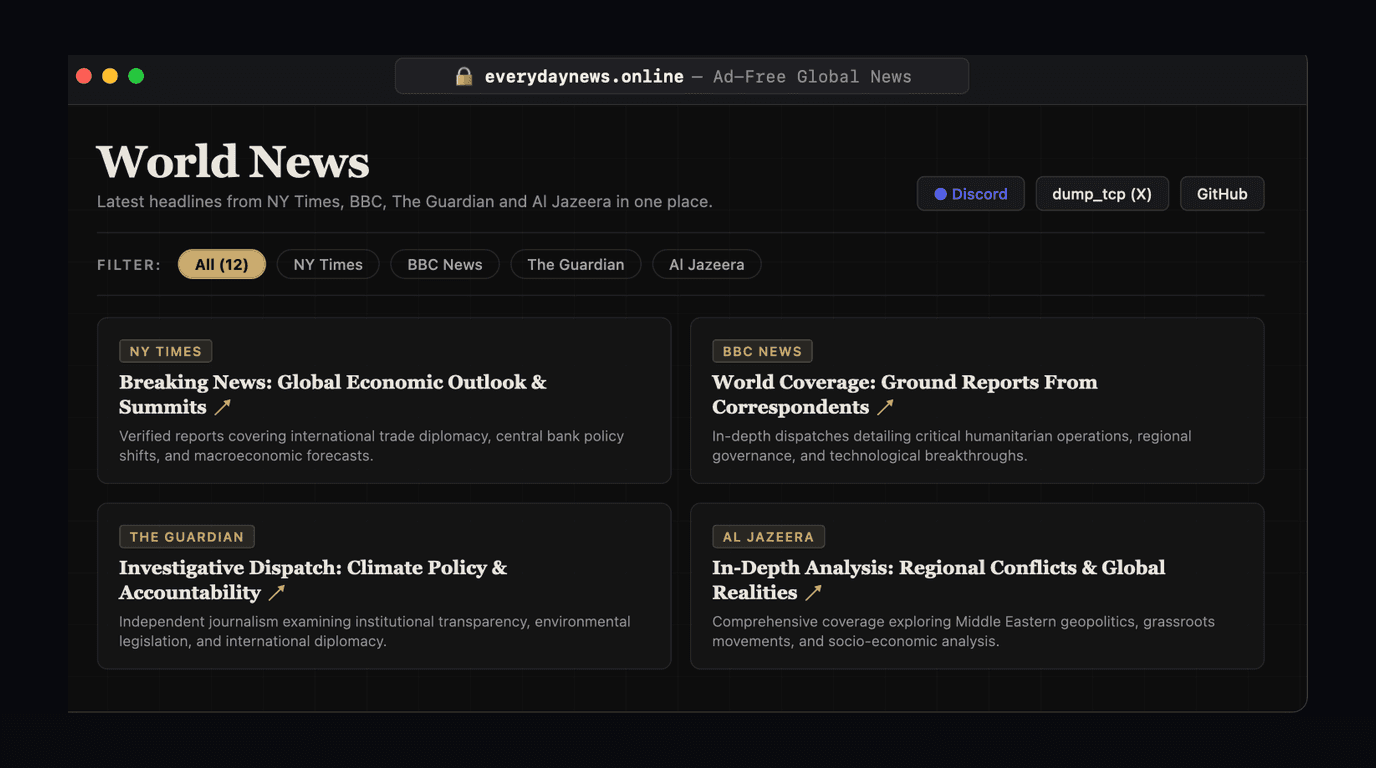
Platform overview: Everyday News dark-mode interface displaying direct multi-source coverage.
Quick Platform Snapshot: Everyday News
What is Everyday News?
Everyday News is an independent, web-based news aggregator designed to deliver the latest breaking global headlines on a single, distraction-free page. Instead of relying on an artificial intelligence recommendation feed or engagement-driven algorithms, the platform curates real-time news updates directly from four globally respected journalistic organizations:
- The New York Times (NY Times) – General breaking news, American and international affairs, and financial market insights.
- BBC News – Global field reporting, top breaking stories, and technology developments.
- The Guardian – Investigative reporting, international diplomacy, world culture, and policy debates.
- Al Jazeera – Deep international coverage, Middle Eastern reporting, and investigative journalism.
Unlike conventional media portals that overload users with autoplay videos, sticky advertisements, paywall popups, and newsletter modals, Everyday News utilizes a clean dark-mode UI with simple filtering tags. Each news entry provides the outlet tag, a descriptive headline, a concise summary, and a direct outbound link to read the full original report.
What is Everyday News Used For, and Who Uses It?
Everyday News is built as a morning briefing console and a continuous headline-monitoring hub. Rather than opening four or five separate browser tabs, closing multiple cookie-consent banners, and waiting for heavy scripts to render, readers open this single website to grasp the global narrative in seconds.
Key Audience Profiles:
Software Engineers & Tech Professionals
Developers value lightweight, terminal-fast websites. Because Everyday News ships minimal JavaScript and uses zero invasive tracker scripts, it loads instantaneously even on constrained connections.
Journalists & Media Researchers
Reporters and analysts who need to cross-examine how the same breaking global story is framed across different editorial cultures (e.g., comparing Western coverage by BBC and NYT with regional coverage by Al Jazeera).
Privacy-Conscious Individuals
Readers who refuse to be tracked by ad networks or profiled by social media algorithms that manipulate content feeds to optimize outrage and screen time.
International Affairs Students & Observers
Students and professionals in geopolitical studies who need high-signal headlines without wading through celebrity gossip or localized clickbait.
Why Was Everyday News Created?
To understand why Everyday News was built, you only need to visit any conventional mainstream news portal in 2026. Within three seconds of opening a typical news website, you are greeted by:
- A massive cookie permission wall with dozens of pre-checked marketing trackers.
- Sticky top banners, side gutter video ads, and floating interstitial popups.
- Intrusive "Subscribe now for $1/month" full-page modals blocking article body text.
- Algorithmic recommendation widgets filled with sponsored clickbait articles.
Everyday News was created as an antidote to this digital decay. The creator recognized that when major geopolitical or financial events break, people simply want to know what happened, what the facts are, and how major newsrooms are reporting it. By stripping away every piece of commercial clutter, Everyday News restores the internet news experience to its original promise: fast, text-first, and transparent.
Who Created Everyday News and Who is the Owner?
Everyday News was created and is independently operated by an engineer and systems programmer who operates online under the pseudonym dump_tcp (also known as tcpdump).
The owner’s technical background is rooted in low-level systems engineering, network packet analysis, and high-performance server architectures:
The creator actively publishes open-source web servers written in Go (such as golangwebserver) and Rust (rustwebserver), demonstrating a strong focus on minimalist memory footprint, blazing execution speed, and resilient network I/O.
Because the site is maintained as an independent project rather than a venture-backed startup, the owner has no financial incentive to inject user tracking, sell visitor behavioral data, or monetize attention with intrusive affiliate ads.
What is the Main Purpose of Everyday News?
The primary purpose of Everyday News can be distilled into three key pillars:
1. Multi-Perspective Editorial Balance
No single news outlet owns the absolute truth on complex international stories. By presenting BBC, The New York Times, The Guardian, and Al Jazeera side by side, readers can spot differing angles, nuances, and editorial emphases instantly.
2. Zero-Friction Information Retrieval
The goal is to let someone check the pulse of the world within 60 seconds without creating an account, granting tracking permissions, or paying monthly subscriptions just to read headlines.
3. Freedom from Algorithmic Radicalization
Social media feeds like X, TikTok, and Facebook are designed to keep users agitated to increase ad views. Everyday News restores chronological, editorial reporting where human editors decide what is significant rather than engagement bots.
Core Features & User Experience
Everyday News is intentionally lightweight. When you navigate to the website, you encounter a clean set of user-focused features:
- One-Click Source Filtering:The interactive filter bar allows users to toggle between "All", "NY Times", "BBC", "Guardian", and "Al Jazeera". Filtering happens instantly in the client without page reloads.
- Categorized Topic Sections:Headlines are neatly classified under sub-sections like Breaking News, World Updates, Business & Finance, Technology Innovations, Politics & Policy, Culture & Arts, and Investigative Reports.
- Dark-Mode Native Palette: Built with a subtle charcoal aesthetic (
#0d0d0dbackground, warm serif masthead, and gold accent tags) that prevents eye strain during early morning or late-night reading sessions. - Outbound Verification Links: Every headline acts as a gateway card with an outbound indicator arrow (↗) that takes you directly to the original publishing newspaper for comprehensive long-form reading.
How Everyday News Compares to Mainstream News Feeds
Here is a direct comparison between Everyday News and traditional corporate news aggregators like Google News, Apple News, and MSN News:
| Feature / Metric | Everyday News | Google / Apple News | Traditional RSS Readers |
|---|---|---|---|
| Ad Load & Popups | Zero Ads, Zero Trackers | Heavy Sponsored Ads & Banners | Depends on feed, usually freemium ads |
| Algorithm Filter Bubble | None (Chronological / Curated) | Aggressive behavioral profiling | None (chronological) |
| Account Requirement | No login, immediate access | Google or Apple ID required | Account creation required |
| Page Load Speed | < 1 Second | 3–8 Seconds (heavy telemetry) | 1–3 Seconds |
| Editorial Diversity | 4 Major Global Perspectives | Vast, but siloed by engagement | Manual feed management required |
Objective Review: Strengths and Limitations
Strengths
- Immediate, zero-click access to verified headlines without paywalls or account creation.
- Instant client-side source filtering between NY Times, BBC, Guardian, and Al Jazeera.
- Extremely fast page response with lightweight footprint.
- Zero invasive surveillance, tracking cookies, or commercial ad networks.
- Clean, readable typography suitable for desktop and mobile reading.
Current Limitations
- Currently limited to four primary news sources; lacks regional and niche industry outlets.
- No built-in search bar to query past archived news stories.
- Clicking on full articles redirects to the original source, which may enforce their own individual paywalls.
- No personalized keyword alerting or custom RSS export for advanced power users.
Frequently Asked Questions (FAQ)
Is Everyday News free to use?
Yes, Everyday News is 100% free with no subscription tiers, paywalls, or hidden costs. You do not need to register an account or provide an email address.
Who owns and maintains Everyday News?
Everyday News is owned and developed by an independent systems and network software engineer known as dump_tcp. The creator is known in the developer community for building high-performance Go and Rust servers and maintains the project independently without corporate backing.
Does Everyday News track user browsing behavior?
No. The site has no third-party tracking scripts, no behavioral fingerprinting, and no advertising pixels. It functions as a clean static gateway to reputable newsrooms.
How is Everyday News different from Google News?
Google News algorithms monitor your search history, location, and reading patterns to construct an engagement-optimized feed. Everyday News removes algorithms entirely, presenting clean chronological headlines directly from verified global newsrooms.
Which publications are aggregated on Everyday News?
As of 2026, the platform aggregates news stories from The New York Times, BBC News, The Guardian, and Al Jazeera across politics, world affairs, finance, technology, culture, and investigative reporting.
Final Verdict: Is Everyday News Worth Bookmarking?
In a digital landscape crowded with bloated, subscription-gated news apps, Everyday News is a breath of fresh air. It does one thing and does it exceptionally well: it aggregates world headlines from leading news institutions without tracking you or selling your attention.
While power users who require hundreds of specialized RSS feeds or deep archiving might still want a dedicated RSS reader like NetNewsWire or Feedly, anyone looking for a fast, honest, and neutral overview of world events will find Everyday News to be an indispensable morning bookmark.
Looking for More Independent & Minimalist Software Alternatives?
Discover handpicked, community-verified alternatives to mainstream software tools, search engines, and media aggregators on FindAlternate.